Avoiding Division Over Political Division




What divides us should never divide us.
Let me restate. The church is full of division. We are divided among racial lines. We are divided among age categories. We are divided among income categories. We each have a category of brokenness that is unique to us and no other. And, yes, there are politically diverse views in the church.
These smaller divisions should combine to make up the tapestry of a church that shouts, by its lived vitality, that differences are all overcome by our love for each other in Christ Jesus. The local church should reflect, as much as possible, the larger church that is made up of every tribe, nation, and tongue.
Yet, these little divisions sometimes creep in and try to assert authority that they do not have. They have no power over the Word of God, his Holy Spirit, and the commandment to love and serve alongside one-another.
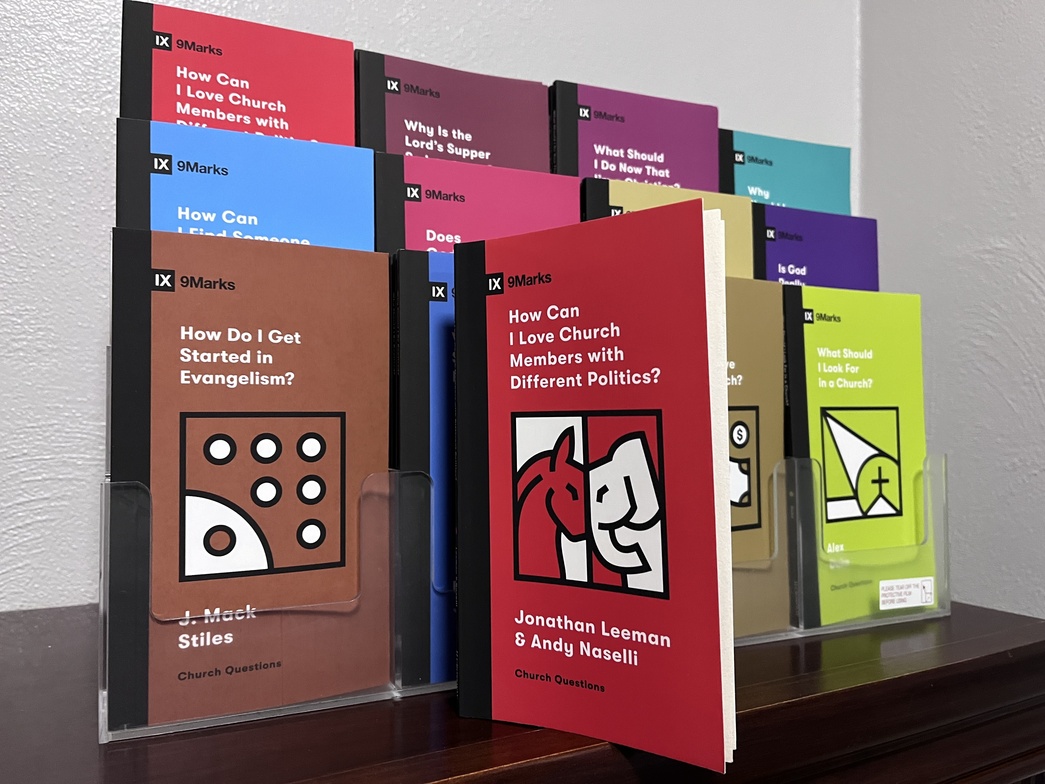
The little divisions addressed in the booklet, How can I love Church Members with Different Politics? (by Jonathan Leeman and Andy Naselli, 9Marks) addresses these issues. The authors first identify why we divide over politics. We do so because identity with Christ has given us a vested interest in worldly justice. When our sense of justice and fairness are opposed, we tend to elevate the matter to one of spiritual doctrine or importance, instead of leaving it as a lesser debatable matter (Romans 14).
The authors give suggestions for church members who worship and work alongside those of differing political views:
1. Adjust your expectations. If you expect a politically homogenous congregation in all respects, you do not have a realistic view of the larger body of Christ. Faithful believers can disagree on matters of practical and political wisdom, like whether taxes should be higher or lower, whether we should blockade the Straight of Hormuz, or whether we should have a stronger military presence in the Asian Pacific region of the globe. The church should be made up of diverse people who come to diverse conclusions on a diversity of issues.
2. Recognize what a church is. The authors assert that churches:
“are communities of former enemies learning to love one another.”
Jesus modeled this aspect when he chose a tax collector, and an anti-tax zealot to serve on his small team of apostles.
3. Know what essential doctrines unite a church, and what beliefs are areas of Christian freedom. Whole church doctrines are essential to faith, and are usually found in a church’s statement of beliefs. Christian freedoms are significant issues, but they stop short of being a “must believe” for church membership.
"You know you have crossed the line into the whole-church domain when the belief or practice becomes possible grounds for removing someone from membership in the church as an act of discipline."
4. Is the issue a “straight line” issue or a “jagged line” judgment. If you can draw a straight line from a command in the Bible to a political position, then it is clearly a whole-of-church position. If you have to implement wisdom in order to implement it in the modern political sphere, then it is a jagged line judgment.
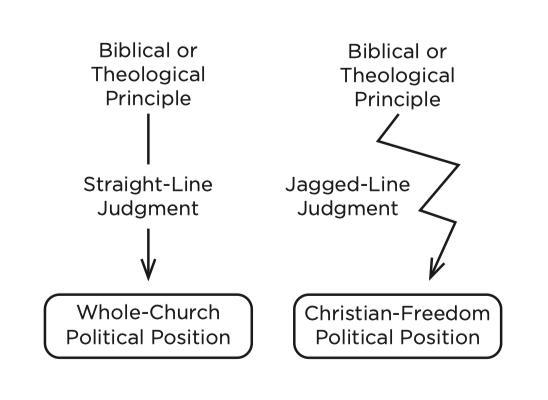
(picture from the booklet, pg. 41)
For example, take the abortion issue. All Christians should believe, directly from Scripture, that abortion is the unjustified killing of a human life. It is murder. However, Christians are free to disagree about how the government should best proceed in saving the greatest number of unborn babies from this terrible tragedy. They draw jagged lines to implement the clear straight line belief, each with the goal of ending the practice entirely.
We can also use the environment as another example. It is clear and direct from Scripture that we are to care for this planet. How the government goes about doing it is a matter of jagged line judgment.
These jagged line judgments mark differences in our wisdom, but should not divide us.
5. Respect your brothers and sisters who have differently calibrated jagged-line judgments. The authors give three ways that we can calibrate our judgments: First by being devoted to God’s Word; second by working it out in the context of the church; and finally, by exercising patience in drawing political conclusions. When we do encounter those who have different jagged-line judgments, we should graciously welcome them as Christ welcomed us (Romans 14:1-2)
6. Remember what is most important. The next election is not the most important thing in all of the civilized world. The Kingdom of God is. Nonetheless, we tend to get excited about politics, devoting our days and hours to them, while neglecting the most important matter at hand – Jesus! How would believers who are in other contexts act on their faith – those who lived in Soviet Russia, modern North Korea, or First Century Rome? They have no say or sway on their governmental context, yet the Word compels them to walk faithfully before God as a church.
Keep the main thing the main thing.
Be a good citizen.
Graciously love the politically diverse church.
Copies of the 9Marks booklet are available for free at Sojourn Church, in the lower entrance bookshelf.